
Is Your Security System Really Protecting You?
August 20, 2026
Essential Guide to Uninterrupted Power with UPS Systems
September 2, 2026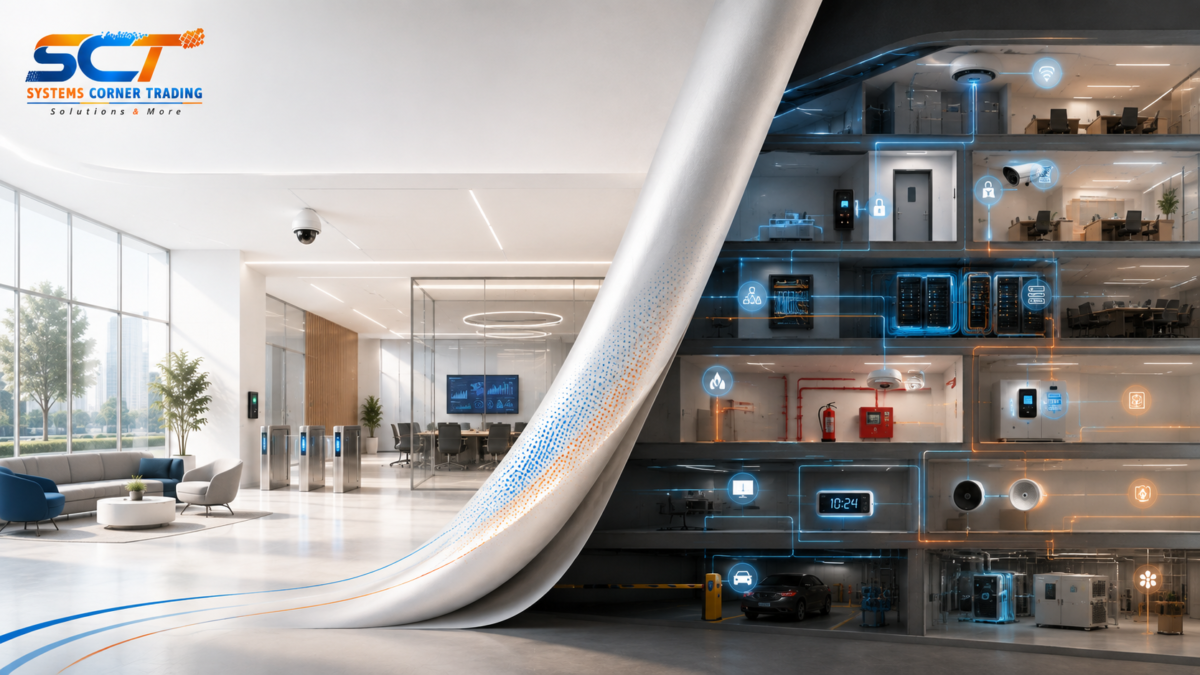
Indeed, the most important integrated building technology in your building may be the technology you never see.
Imagine walking into your office tomorrow morning.
The entrance opens.
The lights are on.
Moreover, your phone connects to Wi-Fi, a component of integrated building technology.
The elevator responds.
Your access card works.
The cameras are recording.
The meeting room is ready.
Your call connects.
Everything feels completely normal.
And that is exactly the point.
You probably didn’t think about a single one of those systems.
You didn’t think about the switches moving data through the building.
You didn’t think about the fiber connecting floors.
You didn’t think about the access controller checking your credentials.
You didn’t think about the server processing information.
You didn’t think about the cables hidden above the ceiling.
And you certainly didn’t think about the infrastructure working quietly behind the walls.
Because when technology works properly…
You stop noticing it.
The Invisible Layer Behind Every Building
Look around a modern building.
You see architecture.
Furniture.
Glass.
Lighting.
Screens.
Doors.
Workspaces.
What you don’t see is the second building hidden inside it.
A digital building.
A network of systems constantly communicating, monitoring, authenticating, recording, controlling, and responding.
Some of it runs through ceilings.
Some of it sits inside racks.
Some of it is hidden behind walls.
Some of it operates from control rooms that most building occupants will never enter.
Yet every minute of every day, it is working.
Behind one simple door…
There may be an access reader, controller, lock, power supply, network connection, server, database, and management platform working together before the door opens.
Behind one Wi-Fi connection…
There may be access points, switches, structured cabling, fiber backbones, firewalls, controllers, and network infrastructure carrying that connection across the building.
Behind one security camera…
There may be PoE switches, data links, recording servers, storage systems, analytics, and monitoring software working continuously.
Behind one meeting-room screen…
There may be AV distribution, network connectivity, conferencing platforms, microphones, speakers, and control systems coordinating the experience.
And Then Something Stops.
No dramatic explosion.
No flashing warning.
No obvious disaster.
Just one small interruption.
The card reader suddenly doesn’t respond.
A video call starts freezing.
A camera disappears from the monitoring screen.
The parking barrier doesn’t open.
A nurse call doesn’t reach the station.
A display loses its connection.
A phone goes silent.
And suddenly…
The invisible becomes impossible to ignore.
The Paradox of Good Technology
There is something unusual about infrastructure.
When it is poorly designed, everyone notices.
When it is properly designed, almost nobody does.
That is because the purpose of infrastructure isn’t to demand attention.
It is to remove friction.
Great technology doesn’t constantly remind people that it exists.
It simply allows everything else to happen.
Think about the best technology experiences you have had.
You don’t celebrate because your access card worked.
You don’t congratulate the network because your video call connected.
You don’t think about the CCTV system because an incident was recorded correctly.
You don’t thank the structured cabling every time a file reaches a server.
You simply expect everything to work.
And behind that expectation is an enormous amount of engineering.
One Building. Hundreds of Invisible Conversations.
Additionally, at any moment, a modern facility may contain hundreds—or even thousands—of connected devices exchanging information through integrated building technology.
A camera sends video.
An access reader sends credentials.
A sensor reports a status.
A phone carries voice traffic.
An access point connects users.
A control panel receives an alarm.
A server stores information.
A management platform processes events.
A building system adjusts equipment.
None of these conversations are visible to the person walking through the building.
But together, they create the experience of a building that simply…
works.
The Real Product Isn’t the Device
A camera is visible.
A speaker is visible.
A screen is visible.
An access reader is visible.
But those devices are only the surface.
What actually makes the experience reliable is everything behind them.
The design.
The infrastructure.
The cabling.
The network.
The power.
The configuration.
The integration.
The testing.
The commissioning.
And the people who understand how all of those pieces fit together.
Because buying technology is easy.
Making technology disappear into the experience is engineering.
The Building Doesn’t Know Where One System Ends
From the user’s perspective, there is no “network system,” “security system,” “AV system,” or “communication system.”
There is only the building.
If the parking gate fails, the building feels broken.
If Wi-Fi disappears, the building feels broken.
If the access door won’t open, the building feels broken.
If the meeting room won’t connect, the building feels broken.
Users don’t care which contractor installed which cable.
They don’t care which switch carries the traffic.
They don’t care which controller sent the command.
They care about one thing:
Does it work?
That’s why modern technology infrastructure has to be designed as an experience, not simply as a collection of products.
Technology Should Follow the User — Not the Other Way Around
A well-designed environment removes unnecessary decisions from the user.
You walk toward an authorized entrance.
It opens.
You enter a meeting room.
The technology is ready.
You move through the building.
Connectivity follows you.
An emergency happens.
The correct systems respond.
Nobody should need to understand the infrastructure behind these actions.
The engineering has already done that work for them.
Complexity should exist behind the scenes.
Simplicity should exist in front of the user.
What “Invisible” Technology Actually Requires
Technology doesn’t become invisible by accident.
It requires careful planning long before anybody starts using the building.
01 — Design
The infrastructure must be designed around what the building needs today and what it may require tomorrow.
02 — Connectivity
Every connected system depends on a reliable physical and network foundation.
03 — Integration
Systems need to exchange information where integration improves security, operations, or user experience.
04 — Redundancy
Critical services should not depend unnecessarily on a single point of failure.
05 — Testing
Every device, cable, connection, and scenario has to be tested before the user depends on it.
06 — Documentation
A system that nobody can understand later becomes difficult to maintain, troubleshoot, and expand.
07 — Support
Infrastructure continues to evolve after commissioning. Proper maintenance keeps the invisible layer invisible.
The Moment Technology Becomes Visible
Most people discover infrastructure at the exact moment they least want to.
During a failure.
A disconnected cable.
A failed power supply.
A misconfigured device.
An overloaded link.
A storage problem.
A system that was installed but never properly integrated.
Suddenly, something that nobody noticed yesterday becomes everyone’s priority today.
The irony is simple:
Infrastructure receives the least attention when it works — and the most attention when it doesn’t.
So What Should a Smart Building Feel Like?
Not futuristic.
Not complicated.
Not full of screens and flashing technology.
It should feel effortless.
Secure without making security inconvenient.
Connected without forcing users to think about connectivity.
Intelligent without constantly advertising its intelligence.
Responsive without requiring unnecessary human intervention.
Technology should exist everywhere it is needed…
and almost nowhere in the user’s mind.
That’s the Standard We Design For.
At Systems Corner Trading (SCT), we work across the technology infrastructure that keeps modern environments connected, secure, and operational.
From network and structured cabling infrastructure to security, communication, audiovisual, and building technologies, our role goes beyond supplying individual devices.
We design the layer behind the experience.
The layer most people may never notice.
And if we’ve done our job properly…
They shouldn’t have to.
Build Technology People Can Depend On — Without Having to Think About It.
Whether you’re planning a corporate office, healthcare facility, educational building, hotel, industrial facility, or smart development, Systems Corner Trading can help design and integrate the infrastructure working quietly behind every interaction.
Talk to SCT about your next project.
GET A FREE CONSULTATION
Let’s Talk
📞 +966 11 269 4437
📱 +966 51 146 4924
📧 info@systems-corner.com
🌐 www.systems-corner.com