Structured Cabling: The Invisible Backbone of Every Smart Building
July 10, 2026
Access Control Systems: The First Line of Defense for Modern Businesses
July 22, 2026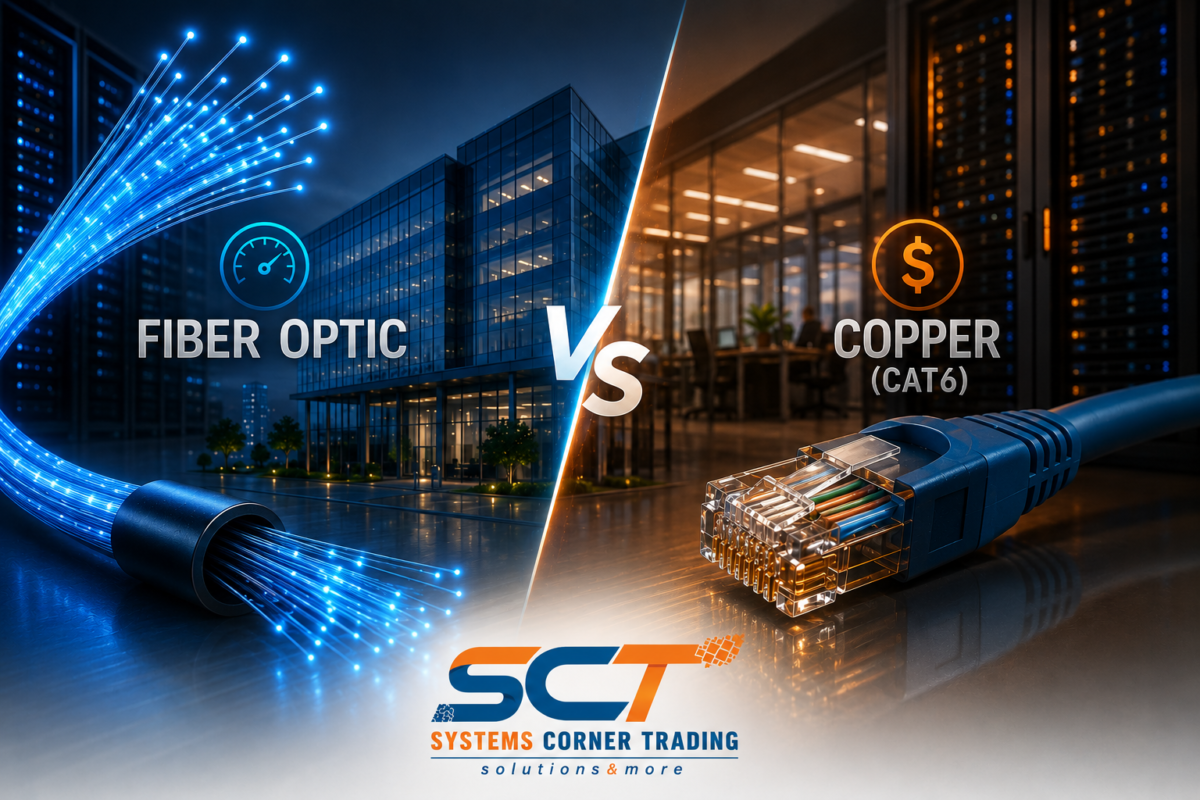
In today’s connected world, network infrastructure is the foundation of every modern business. Whether you’re running an office, managing a data center, deploying CCTV systems, or supporting cloud-based applications, the quality of your cabling infrastructure directly impacts performance, reliability, and scalability.
One of the most common questions businesses face when planning a network is:
Should you choose Fiber Optic or Copper (Cat6) cabling?
Let’s break down the differences and help you determine which solution is right for your business.
Understanding the Basics
Both Fiber Optic and Copper (Cat6) cables are designed to transmit data across a network. However, the technology behind each solution is fundamentally different.
Fiber Optic
Fiber Optic cables use light signals transmitted through glass fibers, enabling extremely fast and reliable data transmission over long distances.
Fiber Optic Advantages:
✔ Uses light instead of electricity
✔ Extremely high bandwidth
✔ Long-distance transmission
✔ Immune to electromagnetic interference
Copper (Cat6)
Cat6 cables transmit data through electrical signals and remain one of the most widely used structured cabling solutions for business networks.
Cat6 Advantages
✔ Lower installation cost
✔ Easy deployment
✔ Excellent office performance
✔ Widely available
Speed, Distance & Performance Comparison
Network performance is one of the most important factors when choosing cabling infrastructure.
| Feature | Fiber Optic | Cat6 |
| ⚡ Speed | 10Gbps – 400Gbps+ | 1Gbps (10Gbps up to 55m) |
| 📏 Distance | Several Kilometers | 100 Meters |
| 🛡 EMI Resistance | Excellent | Moderate |
| 🚀 Scalability | High | Medium |
| 💰 Cost | Higher | Lower |
Which One Wins?
While Fiber Optic outperforms Cat6 in speed, distance, and scalability, Cat6 remains a practical and cost-effective solution for many business environments. The best choice depends on your network requirements, budget, and future growth plans.
When Should You Choose Fiber Optic?
Fiber Optic is the ideal choice for businesses that require maximum performance, long-distance connectivity, and future scalability. As organizations continue to adopt cloud services, smart technologies, and data-intensive applications, Fiber provides the bandwidth needed to support growth without compromising performance.
✅ Data Centers
✅ Smart Buildings
✅ Multi-Building Campuses
✅ Industrial Facilities
✅ Hospitals & Healthcare Facilities
✅ Large CCTV Deployments
✅ High-Bandwidth Applications
When Is Cat6 Enough?
While Fiber offers unmatched performance, Cat6 remains one of the most practical and cost-effective networking solutions available today. For many businesses, Cat6 delivers more than enough bandwidth to support daily operations efficiently.
✅ Small & Medium Businesses
✅ Office Networks
✅ VoIP Systems
✅ Access Control Systems
✅ Standard CCTV Installations
✅ Workstations & Printers
✅ General LAN Infrastructure
Reliability & Interference
Network reliability is critical for business continuity. A stable network minimizes downtime, improves productivity, and supports critical systems.
Fiber Optic
Because Fiber uses light instead of electrical signals, it is immune to electromagnetic interference (EMI), making it highly reliable in environments with heavy machinery or electrical equipment.
Cat6
Cat6 performs exceptionally well in office environments but may be affected by electromagnetic interference and signal degradation in certain conditions.
💡 Winner: Fiber Optic
For environments requiring maximum reliability and signal integrity.
Cost Considerations
Budget is often one of the most important factors when choosing a network infrastructure. While Fiber Optic delivers superior performance and long-term scalability, it generally requires a higher initial investment compared to Cat6 cabling.
Fiber installations may involve specialized equipment, advanced termination techniques, and higher deployment costs. However, they offer significant advantages in terms of bandwidth, reliability, and future readiness.
On the other hand, Cat6 remains a cost-effective solution for many organizations. It is easier to install, requires less specialized equipment, and can support most business applications efficiently without a large upfront investment.
Key Considerations
Fiber Optic:
✔ Higher installation cost
✔ Specialized equipment and expertise
✔ Long-term scalability
✔ Ideal for future expansion
Cat6:
✔ Lower installation cost
✔ Faster deployment
✔ Affordable networking equipment
✔ Excellent value for office environments
💰 Cost Winner: Cat6
For businesses looking for a reliable and budget-friendly networking solution, Cat6 offers excellent performance at a lower cost. However, organizations planning for long-term growth and higher bandwidth demands may find Fiber Optic to be a more strategic investment.
The Best Solution? Sometimes Both.
In many modern projects, the best answer is not choosing Fiber Optic or Cat6 exclusively. Instead, businesses often achieve the highest efficiency by combining both technologies within the same infrastructure.
Fiber Optic can be used for backbone connectivity and long-distance communication, while Cat6 can serve end-user devices and local network connections. This hybrid approach provides excellent performance while maintaining cost efficiency.
Use Fiber Optic For:
✔ Backbone Networks
✔ Data Centers
✔ Server Rooms
✔ Inter-Building Connections
✔ Core Infrastructure
✔ Long-Distance Connectivity
Use Cat6 For:
✔ Workstations
✔ IP Phones
✔ Wireless Access Points
✔ Printers
✔ Security Devices
✔ Office Network Connections
Final Thoughts
There is no universal answer when comparing Fiber Optic and Copper (Cat6) cabling. The right choice depends on your business requirements, budget, infrastructure size, and future growth plans.
If your organization requires maximum speed, long-distance connectivity, and long-term scalability, Fiber Optic is the superior solution.
If your focus is cost efficiency and reliable day-to-day performance, Cat6 remains an excellent choice for most office and commercial environments.
For many businesses, a combination of both technologies provides the ideal balance between performance, flexibility, and investment value.
Why Choose Systems Corner Trading?
At Systems Corner Trading (SCT), we help organizations build reliable, scalable, and future-ready network infrastructures tailored to their operational needs.
Our team specializes in designing and implementing structured cabling systems, Fiber Optic networks, and integrated technology solutions that support business growth while ensuring performance and reliability.
Whether you are planning a new facility, upgrading an existing network, or expanding your operations, SCT can help you choose the right infrastructure for long-term success.
Ready to Build a Faster, More Reliable Network?
Whether you’re planning a new facility, upgrading your current network, or expanding your operations, SCT can help you design the right infrastructure for long-term success.
📞 +966 11 269 4437
📧 info@systems-corner.com
🌐 systems-corner.com